Chronic vomiting becomes an emergency when your pet can't keep water down, brings up blood or dark material that looks like coffee grounds, or retches over and over without producing anything, especially with a swollen or painful belly. Those signs point toward a blockage, bleeding, or a twisted stomach, and they need to be seen right away rather than watched overnight. Vomiting that simply keeps coming back, with weight loss, a fading appetite, or on-and-off diarrhea, has a cause that needs finding, and puppies, kittens, and seniors have the least room to spare while it runs.
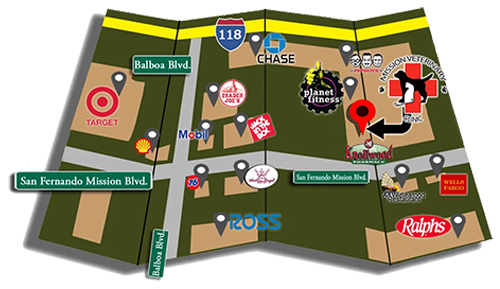
Mission Veterinary Clinic in Granada Hills has provided emergency and urgent care for dogs and cats across the San Fernando Valley for more than 20 years, including the after-hours stretch when your regular vet is closed. Vomiting is one of the most common reasons pets come to us, and our AAHA-accredited hospital has the in-house lab, digital X-rays, and abdominal ultrasound to separate the causes that need treatment now from the ones that call for a longer workup. After weeks of cleaning up and second-guessing yourself, you should not have to be the one deciding whether tonight is different. Because we run on a walk-in, triage-based system, please call us before you come in so we can tell you whether your pet needs to be seen right away.
What Weeks of Vomiting Mean, and When to Stop Waiting
- Vomiting that keeps returning over weeks or months, especially alongside weight loss or a shrinking appetite, points to a cause that needs finding rather than covering up.
- Blood, retching that brings nothing up, a swollen belly, or water that won't stay down turns chronic vomiting into an emergency.
- An emergency visit stabilizes your pet first, and for a pet who has been vomiting for weeks, it usually becomes the first step of a longer workup.
- That workup moves in stages: bloodwork, urine, stool testing, imaging, and often a deworming trial, then a strict diet trial, then endoscopy or a surgical biopsy if the answer is still unclear.
How Do I Know If My Pet's Vomiting Is Serious?
Three things separate a nuisance from a problem: how often it happens, what comes up, and how your pet behaves between episodes. A dog who throws up once, then eats dinner and has the zoomies as usual, is in a different category from a cat vomiting weekly for a month while losing weight. The second pattern needs a workup.
What Can the Vomit Itself Tell Us?
The appearance of vomit shortens the list of suspects before any testing begins, and timing carries just as much weight. Jot down when episodes happen, how long after eating, and how many in a week. A photo beats describing a color from memory in an exam room.
| What comes up | What it can suggest |
| Yellow or green bile | An empty stomach, often overnight, or irritation higher in the digestive tract |
| Undigested food, tube-shaped, soon after a meal | Regurgitation or fast eating rather than true vomiting |
| Dark brown, coffee-ground material | Digested blood, often from a stomach ulcer |
| Bright red blood | Active bleeding in the stomach or esophagus |
| Foamy white liquid | Acid and saliva, common with nausea or a long gap between meals |
When Does This Warrant an Appointment?
Make the appointment once vomiting has repeated across two or three weeks, or once it arrives next to anything else: dropping weight, a fading appetite, more drinking and urinating than usual, low energy, or diarrhea that comes and goes. In cats, hairballs that turn up more than monthly are a vomiting pattern rather than a grooming quirk. Senior pet health lowers the threshold for testing, since kidney, liver, and thyroid disease in older pets often show up first as vomiting.
When Is Chronic Vomiting an Emergency?
Chronic vomiting becomes an emergency when the pattern changes: the vomit turns bloody, retching brings nothing up, water won't stay down, or your pet's belly swells or they seem weak or hard to rouse. Weeks of vomiting quietly drain a pet's reserves, so a bad day that looks like the usual can tip over fast.
A partial blockage, for example, can cause on-and-off vomiting for a month, then close completely in an afternoon. Come in tonight if you see any of these:
- Blood, fresh or digested: red streaks or dark coffee-ground material.
- A swollen or painful belly: a distended abdomen, a hunched stance, or flinching at a light touch.
- Retching with nothing coming up: repeated heaving that produces only foam or air.
- Nothing staying down: water coming back up within minutes.
- Weakness or collapse: a pet who's hard to rouse or has pale gums.
Which Emergencies Can Look Like Ordinary Vomiting?
Some of the most urgent problems we treat start out looking like one more round of the same stomach upset. The clue is usually something happening alongside the vomiting.
| Emergency | The clue that sets it apart |
| Bloat, or a twisted stomach (gastric dilatation-volvulus) | A deep-chested dog retching without result while the belly tightens |
| Complete intestinal blockage | Vomiting that suddenly ramps up, with no stool passing |
| Urinary blockage in a male cat | Vomiting plus repeated litter box trips with little or no urine |
| Acute pancreatitis | Belly pain, sometimes a "praying" stance with the rear end up, often after a fatty meal |
| Addisonian crisis, a shortage of stress hormones from the adrenal glands | Weeks of vague vomiting and weakness that suddenly progress to collapse |
We're here around the clock. Call on your way so we can prepare for you, and never give human anti-nausea or pain medication to a vomiting pet or try to make them vomit a swallowed object unless a veterinarian tells you to.
What Happens If You Bring Your Vomiting Pet In Tonight?
An emergency visit for vomiting has two jobs: make your pet safe tonight and figure out where the problem is coming from. We triage on arrival, run bloodwork in our in-house lab, image the belly for a blockage, and start fluids and anti-nausea medication. Some pets go home by morning, and others stay with us.
- Check vitals and hydration, which tells us within minutes how hard your pet is working to cope.
- Run bloodwork and imaging, looking for the hidden emergencies above and any sign of a blockage.
- Treat what we find, from IV fluids and anti-nausea medication to surgery for a blockage or twisted stomach.
- Decide on home or hospital, with overnight hospitalization and intensive care for pets who need more support.
For a pet who has been vomiting for weeks, that visit is usually step one of the workup below rather than the end of the story.
Why Does My Dog or Cat Keep Throwing Up?
Chronic vomiting is rarely a stomach-only problem. The cause usually sits in one of five places: what your pet eats, something they swallowed, parasites, an organ struggling elsewhere in the body, or disease in the digestive lining itself. Sorting between them is what the workup does, and it can take more than one visit and more than one test.
What If They Ate Something They Shouldn't Have?
Trash raiding, sidewalk snacks, and swallowed fabric all belong high on the suspect list. Partial GI obstructions from a sock, a length of string, or a chewed-off toy piece let some stomach contents pass and hold the rest back, producing weeks of on-and-off vomiting rather than the dramatic collapse most families picture. Cats favor ribbon, hair ties, and tinsel, and anything long and stringy is the worst version, because it can saw into the intestinal wall while it sits there. Blockages and swallowed objects are among the more common reasons pets arrive here after dark.
Could Worms or Other Parasites Explain It?
Yes, and they're easy to miss. Roundworms, common in puppies and kittens, sometimes come up whole, which is exactly as alarming as it sounds. Physaloptera, a stomach worm picked up by eating beetles or cockroaches, causes stubborn on-and-off vomiting in dogs and cats and rarely shows up on a stool test. Cats can pass Ollulanus, a tiny stomach worm, to each other through vomit, and feline heartworm disease often shows up as intermittent vomiting rather than coughing. Giardia can add nausea to its usual diarrhea.
Since one clean stool sample can't rule every parasite out, a deworming trial early in the workup is gentle, inexpensive, and occasionally the whole answer. The Valley's mild winters give parasites no real off-season, so year-round prevention matters here.
Could an Organ Somewhere Else Be Causing It?
Vomiting is often a downstream symptom of an organ that isn't keeping up, and no amount of stomach medication fixes a problem that starts somewhere else.
- Kidneys: chronic kidney disease produces nausea as waste builds up in the bloodstream, which is why an anti-nausea injection may help for two days before the vomiting returns.
- Liver and gall bladder: inflammation or a blocked bile duct interrupts digestion, often with poor appetite and sometimes yellow-tinged gums.
- Thyroid and pancreas: hyperthyroidism causes vomiting and weight loss despite a huge appetite in older cats, and pancreatitis brings real abdominal pain along with the nausea.
What About Disease in the Digestive Tract Itself?
When bloodwork and parasite testing come back clean, the digestive lining becomes the prime suspect.
- Inflammatory bowel disease, persistent inflammation in the stomach and intestinal lining
- Intestinal lymphoma, a gut-lining cancer that mimics IBD in older cats
- Gastric ulcers, which bleed and produce that coffee-ground material
- Bilious vomiting syndrome, bile irritating an empty stomach in the early morning
- Pyloric stenosis, a narrowed stomach outlet seen more in some flat-faced breeds
- Gastric cancer, uncommon but worth ruling out in an older pet losing weight
Could Fast Eating or Stress Be Behind It?
Two ordinary things cause vomiting that looks every bit as medical as disease does: eating too fast and living under stress. Neither shows up on a blood panel, both are fixable, and both get overlooked while everyone waits on lab results.
Is My Pet Eating Too Fast?
Food that reappears whole and tube-shaped within minutes of a meal usually went down faster than the stomach could manage, especially in multi-pet households. Interactive feeders turn a meal that vanishes in seconds into a few minutes of work, which is frequently the whole fix. Separate feeding rooms and smaller, more frequent meals help too.
Can Stress Make a Pet Vomit?
Chronic anxiety changes gut motility and acid production, and cats are especially prone to it. A move, a new baby, a remodel next door, or tension between two pets can all surface as digestive trouble. Stress and anxiety in dogs look like pacing, hiding, excessive licking, or a change in how a dog moves through the household. Stress is never our first conclusion. It's what we weigh once testing comes back clean, and it deserves a real plan.
What Tests Come First When Vomiting Won't Stop?
The workup opens with a full history and a hands-on exam, which is where a surprising amount of the direction comes from. Baseline diagnostics then cover wide territory at once: blood, urine, a stool sample, and imaging, often paired with a deworming trial to take parasites off the table.
| Test | What it can catch |
| Blood panel | Kidney and liver values, blood sugar, thyroid levels, cell counts, markers of pancreatitis, and heartworm status in cats |
| Urinalysis | Early kidney changes, infection, and hydration status |
| Fecal testing | Giardia, roundworms, whipworms, and other parasites, though a negative result doesn't rule out every worm |
| X-rays, sometimes with barium | Foreign material, gas patterns, organ size and shape, and how a meal moves through |
| Abdominal ultrasound | Intestinal wall thickness and layering, lymph nodes, pancreas, liver, and masses too soft to appear on film |
Our veterinary team will go over what came back, what it rules out, and which step makes sense next.
Does My Pet Really Need a Food Trial?
When baseline testing comes back clean, a structured elimination diet is the next real step rather than a last resort. A diet trial only answers the question when it runs eight to twelve weeks with nothing else crossing your pet's lips, no treats, no flavored medications, and no sampling from the other pet's bowl.
Two kinds of food do this job: a novel protein diet built on something your pet has never eaten, such as rabbit or venison, and a hydrolyzed protein diet that breaks an ordinary protein into fragments too small to be recognized. Over-the-counter limited-ingredient bags are not a substitute, since testing has repeatedly turned up proteins in them that never appeared on the label.
When Is It Time for a Scope or a Biopsy?
When bloodwork, imaging, and a strict diet trial all come back without an answer, what's left is looking at the gut lining directly and taking tissue.
What Does Endoscopy Involve?
Endoscopy uses a flexible camera passed down the throat under anesthesia to view the lining of the esophagus, stomach, and upper small intestine and pinch off small tissue samples along the way. No incision is made, and recovery is usually quick. We refer endoscopy to a specialty hospital and handle the scheduling and records ourselves.
When Is Surgery the Better Option?
Exploratory surgery offers what a scope can't reach: a direct look at the liver, pancreas, lymph nodes, and the full length of the intestine, plus full-thickness biopsy samples from several sites during one anesthesia. It makes sense when imaging has already flagged something or a mass or blockage needs to come out regardless. Abdominal surgery and full-thickness biopsy collection are part of what we do here, and we'll talk through anesthesia, recovery, and what the findings could change before anything is scheduled.
What Do the Biopsy Results Change?
Histopathology is the step that ends the guessing. Under a microscope, intestinal lymphoma and long-standing inflammation can look close enough that only the tissue architecture separates them, and those two answers send treatment in completely opposite directions.
What Happens After We Find the Cause?
Once the cause has a name, treatment gets specific, and most pets start feeling better. The plan usually follows one of four paths: clearing parasites, holding a diet that works, calming an inflamed gut with medication, or treating a disease elsewhere in the body. Rechecks let us fine-tune the plan as your pet responds.
When Parasites Were the Problem
Most pets improve quickly on the right dewormer. Year-round prevention keeps the problem from starting over, and with Ollulanus, every cat in the household gets treated.
Food-Responsive Vomiting
Pets in this group often stay well for years on consistency alone. Hold the diet that resolved the symptoms, get the whole household aligned on treats and table food, and glance at the label now and then, since a quiet reformulation can bring symptoms back months later.
IBD Management
IBD usually needs a combination: anti-inflammatory or immunosuppressive medication to calm the lining, plus a diet chosen to support gut function. The first combination isn't always the winning one, and our veterinarians will adjust doses, medications, and food based on how your individual pet is doing.
Treating the Underlying Disease
When kidney disease, hyperthyroidism, pancreatitis, or a liver problem is driving things, the focus shifts to that condition. Stabilizing the core illness typically brings substantial relief from the nausea, sometimes with no stomach-specific medication at all.
Getting to the Bottom of Your Pet's Chronic Vomiting
Chronic vomiting deserves an answer, not a lifetime of cleanup. A methodical workup doesn't always deliver it on the first visit, but it does get there, and your pet shouldn't have to feel rotten while you wait.
Mission Veterinary Clinic is open around the clock here in Granada Hills, and we'd much rather see your pet early in this than after another month of it. Request an appointment when the vomiting is a pattern rather than a crisis, and give us a call first either way so we can tell you the best time to come.